Extending and Strengthening RedCLARA as e-infrastructure for Collaborative Research and Support to Development
The project’s main purpose, which was successfully accomplished, was the consolidation of RedCLARA, the Latin American advanced academic network (similar to GÉANT in Europe). The network was launched in 2004 to facilitate academic interconnection across Latin American universities, particularly for research purposes, and had received significant support in its initial phase from @LIS1.
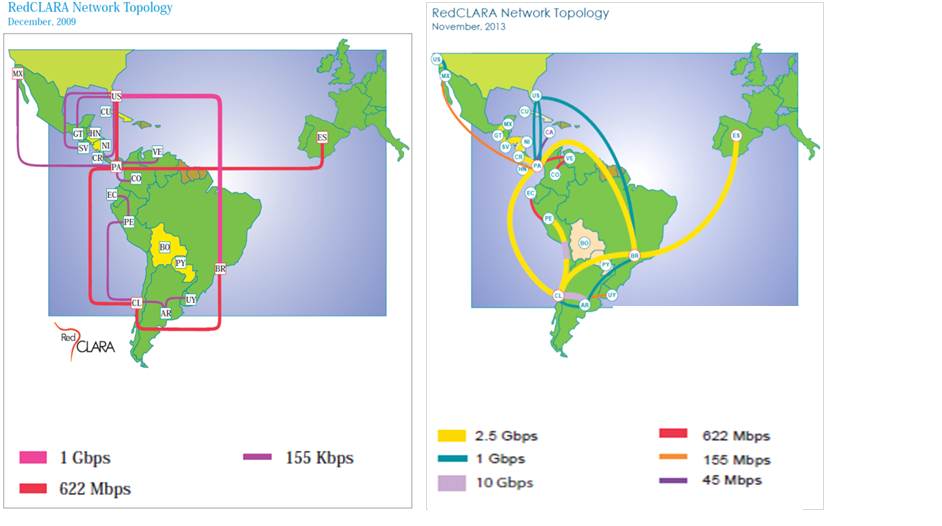
The project has increased the capacity of the network through new optical network infrastructure, resulting in what is now referred to as RedCLARA2. It has also developed a business plan for sustainability. And it worked on extending collaborative research opportunities for Latin American researchers with European counterparts. Fourteen Latin American countries were members of the network at project’s end.
Highlights
The physical RedCLARA2 network is clearly the most important and tangible result of the project. It has become the infrastructure base for collaborative research/education in Latin America and with Europe. The project added nearly 6,000 Km of fibre, and mobilized an additional 2,650 Km from Latin American partners. Latin America now has a powerful and robust digital network which is more than adequate for connecting its research communities. It now extends (with variable speeds) to most of the countries in the region. One of the national coordinators of a RedCLARA work group manifested that without RedCLARA “… there would be regional connections, a few between one country and another and a few international ones, and project initiatives, but implemented independently.” RedCLARA, as is now, would not have existed without EC support, and can be pointed to as a concrete success of EC’s foreign assistance.
Other achievements to highlight include:
- Highly effective and participatory project implementation. ALICE is a good example of a truly networked project, ably managed and generating capacity for all involved (not least for CLARA itself). It was not implemented only by CLARA’s team. The numerous activities carried out (responding to 6 immediate objectives) involved so-called ‘Work Packages Groups’, composed of representatives from the national member networks or NRENs. In addition, there ‘technical or thematic work groups’ dealing with specific issues (usually network operations or services). Internal communication and monitoring took place via the project’s well designed intranet
- A successful exit strategy. A financially sustainable business model was developed and put in place (there a specific objective for Sustainability) by the project. It involved streamlining operations and annual fees from member NRENs ranging from €45,000 to €250,000. CLARA gained the capacity to manage a large network (much larger than the initial RedCLARA), both technically and administratively.
- Extending the network to more countries. The project incorporated 3 new countries into the network, Costa Rica, Bolivia and Paraguay. And there are steps to connect to a new backbone in Central America, paving the way for the entry of Nicaragua and Honduras.
- Increased technical capacity across the region. There have been frequent training activities that have contributed to stronger technical capacity base among NRENs engineers and technicians. It allows them both to (i) better manage their national networks, and to (ii) better take better advantage of the services provided by RedCLARA. This was commonly expressed as one of the most appreciated benefits of the project.
- Advanced, well-planned Communications & Visibility work. The achievement on this area can be considered a best practice (see box in ‘Communications and Visibility‘ section). It should be noted that one of the specific objectives was dedicated to this, so there was a detailed strategy for it from the very start. It created a well architected project web site (included the already mentioned intranet) later complemented by the RedCLARA portal thorough which it provided access to its numerous materials and publications. It used advanced software applications for content management and to disseminate information. But most innovative was the creation of a Public Relations Network with the national NRENs.
Challenges
- The issue of over-capacity . There is a significant challenge on how to make adequate use of the powerful RedCLARA2 network. A professor interviewed indicated that “we may have a great highway, but now we have to bring in the cars”. Because of the relatively low levels of computationally/connectivity- intensive scientific research, fresh efforts ought to turn towards stimulating research and/or make use of the network’s capacity for other purposes (eg. academic/pedagogical).
- Inequality among national networks. Limitations in resources and institutional support for NRENs can make it difficult for some countries to make active use of the network, or even to remain in it. Inequalities can in fact be exacerbated if the stronger networks continue to take more extensive advantage of the new possibilities of RedCLARA. Some NRENs would benefit from well-designed institutional strengthening actions to expanding their universities’ own awareness about collaborative research possibilities as well as advance their own network readiness, and RedCLARA can turn more attention to this.
- Lack of development-related scientific research. For a project that explicitly refers to research activities aimed at satisfying the MDGs, there was little to show in terms of development-related research. Proactive in support of those activities and related user-communities would help.