These recommendations and related specific findings are organized by attributes which together characterized the whole of the program me.
Sustainability
| Findings | Recommendations |
| Achieving institutional sustainability is a significant challenge. Projects like CEPAL-@LIS2 and ALICE2 make major strides by careful planning and a properly implemented exit strategy.Lack of native financial mechanisms in Latin America makes it more difficult to support regional initiatives (Communications/ marketing essential for awareness of funding opportunities). |
|
Policy
| Findings | Recommendations |
| The eLAC process is unique in the developing world. It resulted from (i) sustained support (about 8 years), (ii) a capable technical Secretariat (CEPAL), (iii) political will by key countries, and (iv) obtaining results along the way (decreased broadband rates, prospects for a new fibre-optic ring, etc.).This has achieved the firm positioning of a ‘vaporous’ concept like the Information Society on the Latin America political and development agenda. However, eLAC is however showing signs of slowing down, will need to be reinvigorated to continue serving as the useful policy network that it has become.
The design of @LIS2 was driven by common policy interests of the EU as well as for Latam: (i) Information Society policies, (ii) advanced research networks and (iii) ICT/telecommunications regulatory frameworks |
|
Process
| Findings | Recommendations |
| Regional initiatives with numerous stakeholders are complex to manage. Such initiatives are largely networked projects, with a a capable administrator (network mgr), combining planning and flexibility (eg. CLARA or CEPAL).There was little inter-project collaboration within @LIS2, and areas with potential value for it, e.g. Internet governance, research for social ICT applications, ICT-aided training models, etc.
Proper involvement and communication with key stakeholders during project formulation (i) improves the quality of project design, (ii) internalizes expectations and (iii) facilitates understanding about management procedures: ej..lack of awareness among REGULATEL project stakeholders about administrative compliance may partly be due to lack of proper communications by the EC and/or the implementation agent. |
|
Participation
| Findings | Recommendations |
|
“We have learnt that the construction and maintenance of user communities is a slow and complex process, especially when you are dealing with users coming from different countries.” (ALICE2 final technical report). Community building can be important to a project (particularly to a networked project). But often it is not a specific activity and is noone’s direct responsibility (hardly any explicit work in CEPAL-@LIS2; some but insufficient in RedCLARA). The eLAC process advanced multistakeholder involvement. But it is seen by some (particularly from Civil Society) as a ‘governmental’ process. Multistakeholder involvement is rarely sought by national governments at home. This reduces openess and productivity. It also distances it from the reality of Information Society development (driven by many actors). |
|
Infraestructure/Technology
| Findings | Recommendations |
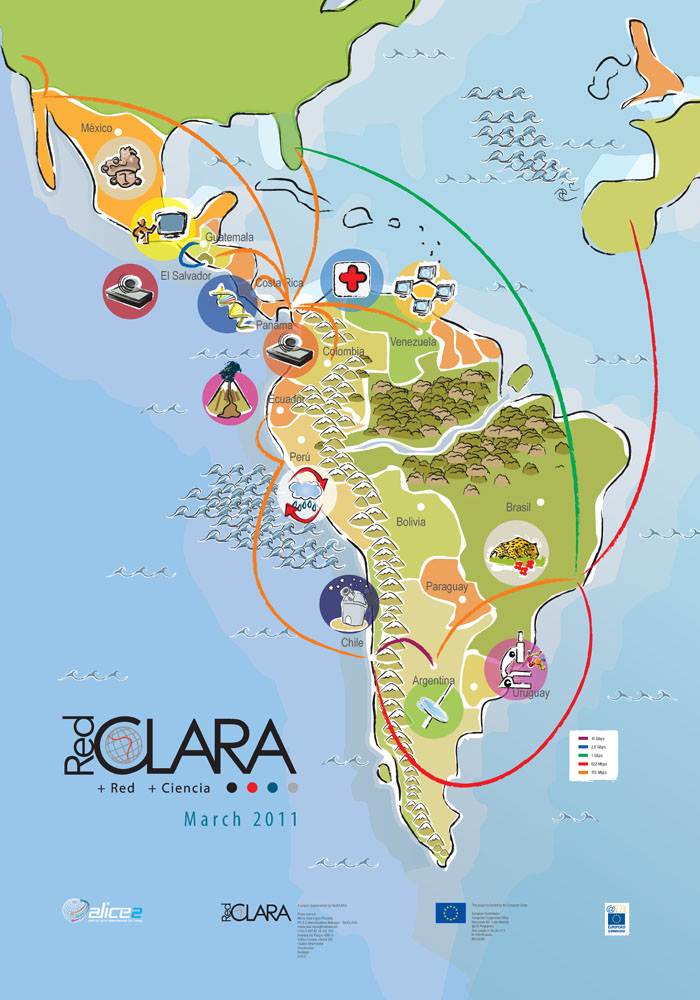
| RedCLARA has reached impressive levels in terms of infrastructure and institutional organisation. But it remains under-utilized. Only a few countries (Brasil, Argentina, Chile, Mexico, Colombia) make significant use of its possibilities. This is probably due to insufficient volumes of research requiring potent connectivity/computational capacity in those countries.ICT convergence (over Internet, through open standards) results in more options for consumers but also more regulatory complexities, making initiatives like the REGULATEL Forum all the more necessary. This includes Internet Governance issues, which are still under discussion at the global stage (some work on IG by CEPAL-@LIS2 and REGULATEL). |
|
Capacity Development
| Findings | Recommendations |
| @LIS2 acted principally on capacity development, with the three main entities (CEPAL, CLARA, REGULATEL) improving their technical and/or management capacities, and that of many related stakeholders. Institutionally, CEPAL and CLARA successfully handled much larger project management responsibilities that they had at the start of the programme. |
|
Communications/Visibility
| Findings | Recommendations |
| Succesful Communications work requires explicit strategies. CLARA and CEPAL communicated well about the activity of their projects because they knew what to do, did not have to improvise.In particular, ALICE2 C&V work can be considered a best practice, both for external and internal communications. For example, they set up the Public Relations Networks among their NRENs, so Communications became a shared, organized and more productive responsibility.Institutional Communications is rapidly becoming a bi-directional process in the web 2.0, social networks era. Using one-dimensional strategies and tools (CEPAL) it is difficult to establish communities of practice or to obtain significant levels of participation. |
|