‘Inclusive Political Dialogues and Exchange of Experiences’
CEPAL-@LIS2 was essentially a policy-oriented Project, and more specifically a project about political dialogue on ICT and Information Society policies.
It was prompted by regional demand for continued support to the eLAC process, covering its 2nd and 3rd phases, eLAC 2010 and (partially) eLAC 2015, respectively. And it responded to expectations, generating important outcomes, some of them not initially considered (such as contributions to decreasing connectivity costs in many countries).
The project went beyond supporting the eLAC process. It included actions like (i) a new Regional Dialogue on Broadband starting in 2010 (not included in the initial plans), (ii) the Dialogue for Inclusive and Innovative Digital Agendas, and (iii) Sectorial Dialogues about productive sectors (mainly for SMEs), e-health, e-education, e-agriculture, etc.
Highlights
The main achievement of the project is the installation of the Information Society and ‘ICT for Development’ in the political (and development) agenda of Latin America. The eLAC process, as a framework for a regional digital agenda and a collaborative space for policy-making on the Information Society, is unique among developing regions.
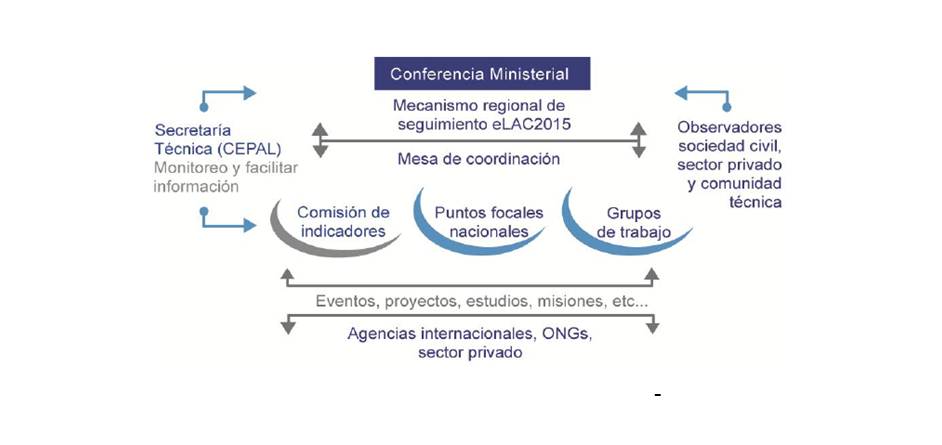
CEPAL carried out a highly effective role as technical Secretariat for eLAC process, and it probably would not have possible as presently exists without its coordination and dynamization.
Other significant achievements include:
- Contributions to reductions in broadband costs . From the creation of the Regional Dialogue on Broadband in 2010 until the end of 2012, the price fell by 67%, and connection speeds increased an average of 178%[2].
- Stimulation to the preparation/updates of broadband national plans . In Argentina, Brazil, Chile, Colombia, Costa Rica, Dominican Republic, Ecuador y México (and others shortly, like Peru).
- A well executed exit strategy with excellent prospects for sustainability .
- A new unit formed to manage the project evolved into CEPAL’s present Information Society Division. Most of the interviewed eLAC stakeholders said that after the project’s end the eLAC process continued to function much as before.
- CEPAL also obtained the approval of LAC countries and the UN to form a new subsidiary instrument, the ‘Conference of Science, Innovation and ICTs’, with which CEPAL will continue to provide support to the region in these topics.
- CEPAL has made ‘Digital Economy with Equity’ a strategic proposition for the region.
- Widespread adoption of Digital Agendas . About 65% of LAC countries now have an active one and 10 of them created a new one or updated it since 2009. The project directly supported Bolivia, Paraguay and Ecuador for the preparation of their first Digital Agendas.
- Two upcoming major infrastructure initiatives that reportedly emerged, at least in part, from the Dialogues: (i) a fibre optic ring in UNASUR countries (expected to reduce tariffs between 15% y 50%), and (ii) a new submarine cable between Europe and Latin America, to improve and lower LA’s outward connectivity costs.
Challenges
- A relatively rigid/closed approach for the eLAC process , diminishing the potential for participation of other willing/competent stakeholders. There was valuable multistakeholder involvement but primarily at the time of key events (i.e. Ministerial Conferences) when plans of action were either crafted or reviews. But some informants opined that the eLAC process was a quasi governmental-only process, removed and hard to connect. They mentioned that multistakeholder involvement was sporadic, particularly at the national level (or even in the Working Groups)
- Lack of communities of practice . CEPAL promoted research on development applications of ICT (health, education, productive sectors, etc.), but as one-time actions. It could have established communities of practice under the CEPAL-@LIS brand, which would have increased the quality and effective of knowledge management, as well as stimulated the participation of more thematic specialists.
- One-directional information channels . While the valuable information produced by CEPAL in the context was openly shared and easily available, it resembles an information repository or virtual library. In the Network Society paradigm and with Web 2.0 tools (e.g. social networks) it has become customary to establish two-way communications with stakeholders and the public. For example, it did not have a blog (for substantive contributions and debate) or Facebook space (for more fluid communications).
(the image below represents the structure set up by CEPAL for the eLAC process)